Gut Health Probiotic CFU: At Manufacture vs at Expiry
Quick Answer: Which CFU Number Should You Trust?
The CFU count guaranteed at expiry is the one to look for on a gut health probiotic. A count at time of manufacture shows what was alive on bottling day, before shipping and months on your shelf. A count guaranteed through end of shelf life describes the dose you will actually swallow.
- Look for: the words "at expiry", "through end of shelf life" or "guaranteed potency".
- Be cautious with: "at time of manufacture", or a CFU figure with no timing wording at all.
- Remember: the strain code and storage instructions matter as much as the size of the number.
What a CFU actually counts
CFU stands for colony forming units, and it is worth being precise about what that measures. Take a sample of the powder, spread it on a growth plate, incubate it, and count the colonies that appear. Each colony grew from at least one cell that was alive and capable of dividing. CFU is therefore a viability count. It does not tell you the weight of the culture, the mass of the capsule, or how much of anything is in there by milligram. It tells you how many living, dividing-capable cells were present at the moment the test was run.
That last clause carries all the weight. A CFU figure is a snapshot with a timestamp, and a live culture is not a stable chemical. Vitamin C in a tablet degrades slowly and predictably. A freeze-dried bacterial culture is a population of dormant organisms, and populations die off. Every count you see on a carton was true at some particular moment, and the label is supposed to tell you which moment that was. When it does not, the number floats free of any promise.
This is also why CFU counts are written in billions when everything else on a supplement panel is written in milligrams. You are not comparing quantities of a compound, you are comparing headcounts of an organism. It makes probiotic labels look impressive and difficult to compare at once, which is a large part of why the timing wording gets so little attention.
Why the manufacture-date number is the easier one to print
Printing "at time of manufacture" costs a maker nothing. The culture is at its freshest the day it is blended and encapsulated, so the count is at its highest, and the claim is trivially easy to substantiate: run the plate count on the finished batch, print the result, done. No modelling, no stability programme, no commitment about what happens next.
Guaranteeing a count at expiry is a considerably harder promise. To make it honestly, a manufacturer has to run stability testing, hold batches at defined temperature and humidity, count them at intervals across the intended shelf life, and then formulate with enough headroom that the number still holds at the end. That headroom is called overage, and it means deliberately putting in more culture than the label claims so the label claim survives the journey. It is real work and real cost, and companies that do it generally say so on the carton, because it is a genuine differentiator.
So the timing phrase is not a technicality. It is a rough proxy for whether a company has invested in stability at all. Two products can print the same headline figure while one has been engineered to still deliver it in eighteen months and the other has not been tested past the loading dock.
What happens between the factory and your kitchen
Live cultures are undone by three ordinary things: heat, moisture and oxygen, the same variables that dominate the published work on probiotic viability and shelf life. A pallet sitting in a distribution centre through a hot summer, a shipping container crossing a warm ocean, a delivery van in July, a bathroom cabinet next to a shower — each is a small withdrawal from the count. Moisture is the quiet one. Freeze-dried cells are stable while they stay dry; let humidity reach them through a poorly sealed bottle and the die-off accelerates sharply.
Packaging is the counter-move, and it tells you something. Individually sealed blisters, desiccant packs, opaque bottles and moisture-barrier films all exist because the industry knows exactly how fragile the payload is, and the same panel that carries the storage line also carries the allergen and cross-contact statements worth reading before you buy. A shelf-stable claim on a product in a well-sealed blister is more plausible than the same claim on loose capsules in a jar you open twice a day. None of this is exotic chemistry; it is simply the reason the number on the front and the number in your hand can differ.
The practical upshot for a buyer is that storage advice on a label is not filler. If a carton says keep cool and dry, or refrigerate after opening, the potency guarantee is conditional on you doing that. Following it is free, and ignoring it can quietly undo the thing you paid for.

Checking a label before you commit
If you are comparing the best gut health supplement options and want to see how a formula lays out its ingredients, doses and guarantee wording, the official product page is where those details live.
See the Official Label & OptionsHow to read a gut health supplement probiotic label in sixty seconds
Work through four things in order and you will have learned most of what a carton can tell you. First, find the CFU figure and read the words immediately around it. "At expiry" or "through end of shelf life" is the strong version; "at time of manufacture" is the weak version; no wording at all is the version that tells you nothing. Read the serving size in the same glance, because a serving defined as three capsules inflates every figure on the panel.
Second, look for strain codes. A genuine probiotic strain is identified by genus, species and a strain designation — a string of letters and numbers after the species name. Without that code you know the species but not the strain, and evidence in this field is strain-specific. Third, check whether the CFU is stated per capsule or per serving, and how many capsules make a serving; a headline count that requires three capsules is a different product from one that delivers it in a single capsule.
Fourth, read the storage line and the expiry date on the pack in the shop. A product that is close to its expiry date is closer to the floor of its guarantee than the ceiling. None of this requires expertise, and it separates a carefully made gut health supplement probiotic from one that is mostly a large number on a bright label.
What the label wording actually promises
| Wording on the pack | What it guarantees | Strength of the promise |
|---|---|---|
| "X billion CFU at expiry" / "through end of shelf life" | That count is still viable on the last day of shelf life, stored as directed | Strong — requires stability data |
| "Guaranteed potency" with a date reference | Usually the same promise, worded for marketing | Strong, if the date reference is present |
| "X billion CFU at time of manufacture" | Only what was alive on bottling day | Weak — says nothing about your dose |
| "X billion CFU" with no timing wording | Nothing verifiable | Weakest — assume manufacture date |
| Species named, no strain code | Family, not the studied organism | Weak — evidence is strain-specific |
Why a bigger CFU number is not automatically better
The billions arms race is the most visible feature of the category and the least informative. Doses in the human research the NIH Office of Dietary Supplements summarises for probiotics vary widely by strain and by the outcome being studied, and many trials have used amounts in the low billions per day rather than the enormous counts that dominate shelf displays. More cells of a strain with no relevant evidence behind it does not become better evidence. It becomes more cells.
There is also a tolerance dimension. Some people starting a high-count product notice gas or bloating in the first days, which typically settles. Starting lower and building up is a reasonable approach for a sensitive gut, and it is an argument against automatically reaching for the largest number on the shelf. The sensible question is not "how many billions" but "which strain, at what dose, guaranteed at what point, and studied for what".
A CFU count tells you how many cells were alive, not what they did once they arrived. Viability is a prerequisite for a probiotic working, never a proof that it will.
This distinction runs through the whole category. It is the same logic we apply when reading the botanical side of a formula — our look at green tea and green coffee evidence for weight loss makes the same point about standardised extract figures. A number on a panel is a starting point for a question, not an answer to one.

Buying a multi-month supply changes the maths
Bulk packs are the standard offer in this category, and they interact with everything above. If you buy a six-month supply, the final bottle will be opened months later than the first, at a point noticeably closer to the expiry date. With an at-expiry guarantee that is fine by design, because the guarantee covers that last day. With an at-manufacture figure, you have no stated floor at all for what is in that last bottle. That is the same per-day arithmetic we run in our buyer's guide to weight loss capsules, and it is why bundle pricing deserves a second look.
This is a practical reason to weigh guarantee wording more heavily than headline count when you are choosing a larger pack, and it is one of the more useful things to check when you are working out where to buy weight loss supplements safely rather than simply cheaply. Check the printed expiry date on arrival, store the unopened bottles somewhere cool and dark rather than above a stove or in a bathroom, and open them in order. These are unglamorous habits that protect the dose you paid for.
What CFU counts cannot tell you
Being honest about the limits matters more than another paragraph of enthusiasm. A CFU count cannot tell you whether a strain will survive stomach acid and bile in a living person, a limit the National Center for Complementary and Integrative Health states plainly, whether it reaches the colon in useful numbers, or whether it will do anything you notice. It cannot tell you whether the specific blend in front of you has ever been tested as a blend, which is usually has not been. Formulas are combinations; evidence is generally per strain.
It also cannot substitute for medical care. Probiotics are foods and supplements, not treatments, and nothing here is a claim that any product diagnoses, treats, cures or prevents disease. Evidence for probiotics is genuinely mixed: some strains have reasonable support for specific narrow uses, many marketed uses have thin or conflicting data, and results in one population do not automatically transfer to another. If you have ongoing digestive symptoms, unexplained weight change, or a compromised immune system, that is a conversation with a clinician, not a shopping decision.
Finally, a guarantee is only as good as the company standing behind it. Independent third-party testing, a published certificate of analysis, or a recognised quality seal all add weight that no printed number can supply on its own. Where a brand offers none of these, treat the figure on the front as a marketing claim, because that is what it is.
Medical note: this article is general information, not medical advice. Speak to a healthcare professional before starting any supplement, especially if you are pregnant, nursing, immunocompromised, or taking medication.
Scientific references
- NIH NCCIH — Probiotics: What You Need To Know
- NIH Office of Dietary Supplements — Probiotics fact sheet for health professionals
- Mayo Clinic — Probiotics and prebiotics: what you should know
- PubMed — literature on probiotic viability, storage and shelf life
- Harvard T.H. Chan School of Public Health — The Microbiome
Frequently asked questions
What does CFU mean on a probiotic label?
CFU stands for colony forming units. It is a count of how many bacterial cells in a dose are alive and able to multiply when grown in a laboratory. It is a viability count, not a weight, which is why probiotic doses are written in billions rather than in milligrams.
Is CFU at manufacture or CFU at expiry better?
CFU at expiry is the more useful number, because it is the amount the maker guarantees is still alive on the last day of shelf life. A count at time of manufacture describes the product on the day it left the factory, before months of shipping and storage, so the dose you actually swallow can be lower.
Does a higher CFU count mean a better probiotic?
Not on its own. Studies use doses that vary by strain, and a very large count of an unstudied strain is not better than a modest count of a well studied one. Strain identity, the guarantee point and evidence for the specific strain matter more than the size of the number.
Do probiotics need to be refrigerated?
It depends on the strain and the packaging. Some cultures are freeze dried and blister packed to be shelf stable, while others hold their count far better cold. Follow the storage line on the carton, because a potency guarantee only applies if the product was stored the way the label specifies.
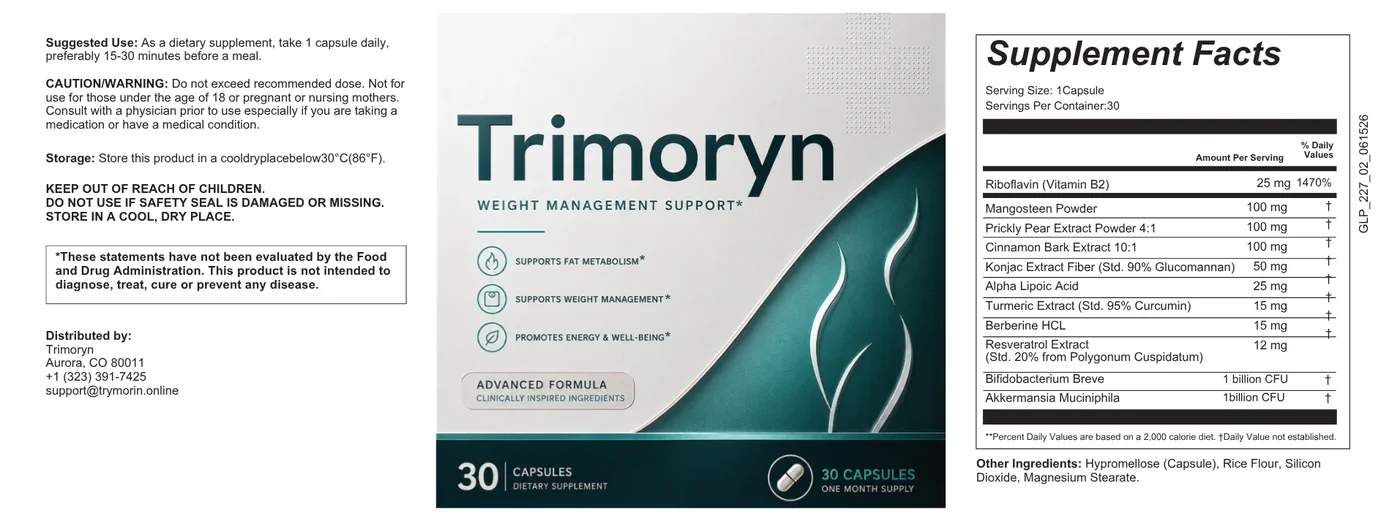
Where can I see the probiotic details for Trimoryn?
The official Trimoryn website lists the formula, including its two probiotic strains, Bifidobacterium breve and Akkermansia muciniphila.

See how Trimoryn presents its formula
If label wording is the standard you are applying, apply it here too. Our full breakdown of Trimoryn lays out each ingredient and what the evidence does and does not support, and the official page carries the current supply options and guarantee terms.
Check Availability on the Official Site